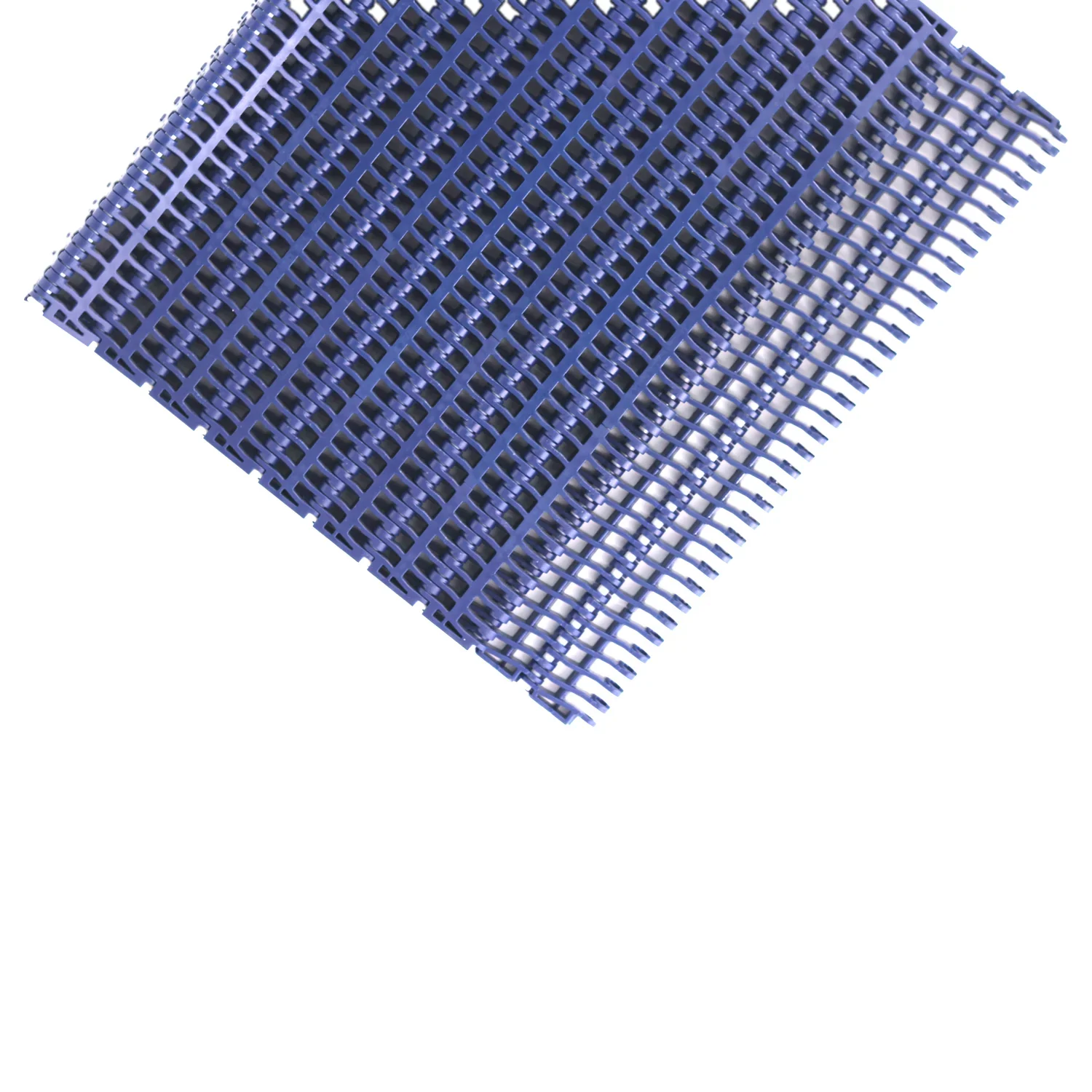
Flush Grid Belt for Empty Can Conveying
XCY27200B1- Pitch
- 27.2 mm
- Thickness
- 8.8 mm
- Pin Ø
- 4.6 mm
- Backflex Radius
- 35 mm
A 27.2 mm-pitch flush grid belt with 43% open area for conveying rubber profiles through cooling and drainage sections.
Usual reply time
Review conveying applications, design features and operating conditions before choosing a belt or chain.
A flush grid modular belt carries rubber profiles along a straight conveyor section.
Match the belt width and contact area to the profile dimensions.
Select the belt material and configuration for product temperature and conveyor conditions.
Cooling water passes through the belt’s 43% open grid and falls into the equipment’s catch pan below. Keep the openings clear and provide suitable water collection beneath the wet conveyor section.
Coplanar grid ribs provide contact support for rubber profiles while retaining an open belt surface. Match the contact width, flexibility and temperature of the profile to the selected belt configuration.
Releasing the rod retainers and withdrawing the relevant transverse hinge rods allows damaged modules to be replaced locally. Stop and isolate the conveyor before maintenance, then refit and secure the rods and retainers before restarting.
Share your required specifications, quantity, delivery location and target date, plus any special requirements. We aim to reply within 10 hours.
Compare belt dimensions and material performance to check your conveyor fit, load and operating conditions.
| Units | Pitch | Thickness | Pin Ø | Width Min. | Backflex Radius | Width Increment | Open Area |
|---|---|---|---|---|---|---|---|
| mm | 27.2 | 8.8 | 25 | 43 % | |||
| in | 1.071 | 0.346 | 0.984 |
| Dimension | mm | in |
|---|---|---|
| Pitch | 27.2 | 1.071 |
| Thickness | 8.8 | 0.346 |
| Pin Ø | ||
| Width Min. | ||
| Backflex Radius | 25 | 0.984 |
| Width Increment | ||
| Open Area | 43 % | |
| Belt Material | Rod Material | Working Load | Belt Weight | Temperature Range |
|---|---|---|---|---|
| POM | PA | 22000 N/m | 5.8 kg/m² | -40–85 °C |
| POM | PP | 19800 N/m | 5.7 kg/m² | -40–85 °C |
| PP | PP | 12000 N/m | 3.8 kg/m² | 5–105 °C |
| PE | PE | 7500 N/m | 4.1 kg/m² | -60–65 °C |
Working loads are specified per unit belt width at 21 °C. Belt and rod combinations have different load and weight values; confirm the permitted load at the actual operating temperature.
Share belt or chain photos (both sides), sprocket and interface photos, key dimensions, conveyed product details, operating conditions and special requirements.
Check FitProvide belt or chain width, loop length and available installation and return clearance.
Allow for running clearance; nominal width alone is not an installation check.Share sprocket photos, tooth count, shaft bore dimensions and equipment interfaces.
Matching pitch alone does not establish sprocket compatibility.Provide product size and weight, line speed, transfer gaps, temperature and cleaning conditions.
Confirm the configuration for the actual process before ordering.More answers about product selection, installation and maintenance.
It describes the proportion of open space in the belt surface. Cooling water can pass through the grid, while the cooling station supplies and collects the water. It is not a cooling-efficiency rating or a complete water-recirculation system.
Yes. With the conveyor stopped and isolated, release the appropriate rod retainers and withdraw the hinge rods needed to access the damaged module. Replace the module locally, then reinstall and secure the rods and retainers according to the maintenance procedure before restarting.
Selection depends on the rubber inlet temperature, cooling medium, required load and line speed. POM, PP and PE belt configurations have different operating ranges; provide the actual process conditions to select the belt and rod combination.
Provide the required belt width and loop length, photos of both belt faces and sprockets, tooth count and shaft bore dimensions. Include the rubber profile dimensions, operating temperature and speed. Equal pitch alone does not confirm interchangeability.
Get belt specifications, sprocket data and installation drawings to check dimensions and plan your equipment.
Dimensions, materials, working load and operating conditions.
Tooth counts, bore sizes and sprocket dimensions for drive matching.
Product geometry, mounting dimensions and installation clearances.
Tell us the model and the documents you need for selection or installation.
Request Documents

For quick back-and-forth, share site photos, ask product questions and discuss your application.
+86 17317161237